Digestive Residues Test
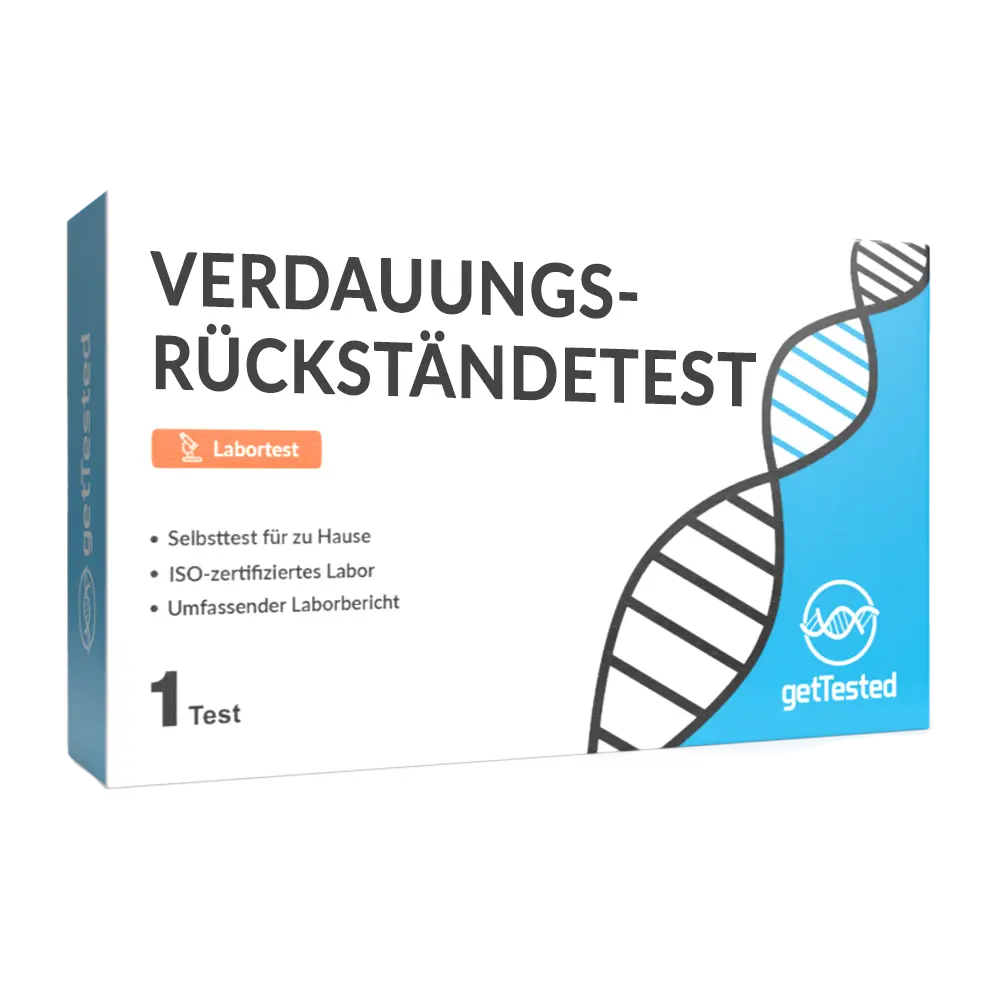
Check undigested food particles with a finger-prick blood test to assess digestion. Fast, accredited lab analysis.
Produktdetails: EUR 69.99 — InStock — SKU A180 — GetTested
Über diesen Test – Digestive Residues Test
Key Benefits
Assess Digestive Function: Evaluate how efficiently your body breaks down and absorbs nutrients.
Measure Digestive Residues: Analyze fat, protein, sugar, and water content in stool.
Simple At-Home Testing: Collect your stool sample easily at home.
Detailed Digital Results: Access your laboratory results online after analysis.
Gut Health Insights: Gain insight into digestion, absorption, and gastrointestinal balance.
What This Test Measures
This test measures several digestive residues in stool, including:
Fat Residues – Evaluates fat digestion and absorption.
Nitrogen Residues – Provides insight into protein breakdown and digestion.
Sugar Residues – Assesses carbohydrate digestion efficiency.
Water Content – Reflects stool consistency and digestive balance.
Elevated levels of digestive residues may indicate impaired digestion, malabsorption, enzyme insufficiency, or gastrointestinal imbalance.
About Digestion and Gut Function
Efficient digestion is essential for proper nutrient absorption and overall health. The digestive system relies on enzymes, stomach acid, bile production, and gut function to break down food and absorb nutrients effectively.
When digestion or absorption is impaired, nutrients may remain in the stool rather than being fully utilized by the body. Measuring digestive residues may provide additional insight into digestive efficiency and gastrointestinal health.
How It Works
Order Your Kit: Purchase your test online.
Collect Your Sample: Use the stool collection kit at home.
Send It Back: Mail your sample to the laboratory using the prepaid return envelope.
Receive Results: Access your digital laboratory results online after analysis.
Sample Collection
The sample is collected using a simple stool test at home. Follow the included instructions carefully and return the sample to the laboratory using the prepaid return packaging provided in the kit.
Accredited Lab and Analysis
Your sample is analyzed in an accredited laboratory using established photometric analysis to ensure accurate and reliable measurement of digestive residues in stool.
Enthaltene Biomarker – Digestive Residues Test
- Quantitative Bestimmung von Stickstoff: Die quantitative Bestimmung von Stickstoff (N) ist ein Labortest, der den Stickstoffgehalt in Körperausscheidungen, typischerweise Urin oder Kot, misst, um die Proteinverdauung und -aufnahme zu beurteilen. Dieser Test ist wichtig zur Bewertung des Ernährungsstatus, insbesondere in klinischen Umgebungen, in denen eine Protein-Energie-Mangelernährung oder Ungleichgewichte bestehen können. Er liefert
- Quantitative Bestimmung von Wasser: Die Stuhlwasseranalyse ist ein Test, der die Menge an Wasser im Stuhl misst. Diese Untersuchung ist wichtig für die Diagnose von Erkrankungen, die mit einer abnormalen Wasseraufnahme oder -sekretion im Magen-Darm-Trakt zusammenhängen. Sie hilft, Ursachen von Durchfall zu erkennen, der durch Infektionen, entzündliche Darmerkrankungen (IBD), Reizdarmsyndrom (IBS) oder Malabsorptionssyndrome verursac
- Quantitative Bestimmung von Zucker: Der quantitative Stuhlzuckertest ist ein diagnostisches Instrument, das die Menge bestimmter Zucker im Stuhl misst, um eine Kohlenhydrat-Malabsorption zu beurteilen. Er hilft, Zustände wie Laktoseintoleranz, Fruktoseintoleranz und andere Störungen der Zuckerverdauung und -aufnahme zu erkennen. Durch den Nachweis unverdauter Zucker wie Laktose, Fruktose oder Sorbit im Stuhl unterstützt dieser Test
- Quantitative Bestimmung von Fett: Der Stuhlfettauswertungstest ist ein diagnostisches Verfahren, das die Menge an Fett in Stuhlproben quantitativ bestimmt. Er dient zur Beurteilung der Fettaufnahme und zur Erkennung von Malabsorptionssyndromen. Erhöhte Fettwerte im Stuhl, bekannt als Steatorrhoe, können auf Verdauungs- oder Aufnahmeprobleme im Gastrointestinaltrakt hinweisen. Dieser Test unterstützt die Diagnose von Erkrankungen w
So bereiten Sie sich vor – Digestive Residues Test
Maintain a normal diet containing fats, proteins, and carbohydrates for 3 days prior to collection to ensure accurate residue measurement.
Häufig gestellte Fragen – Digestive Residues Test
How does it work? / When do I get my results?
Order and receive your kit. 2. Perform the test. 3. Send a sample at the beginning of the week (to avoid delays). 4. Results digitally in 10–15 business days.
What does it mean if my residue levels are high?
Elevated levels of fat, protein (nitrogen), or sugar in your stool suggest that your body is not effectively breaking down or absorbing these nutrients. This can be caused by various factors including insufficient digestive enzymes, low stomach acid, rapid transit time, or damage to the intestinal lining where absorption occurs.
Do I need to follow a special diet before the test?
No specific fasting is required, but it is recommended to maintain your usual diet in the days leading up to the test. This ensures the results reflect how your body typically processes the foods you normally eat.
Kundenbewertungen – Digestive Residues Test
4.8/5 (4)
- 5/5 — Fast shipping and the instructions were very clear.
- 4/5 — Gave me the data I needed to talk to my doctor about my protein absorption. It took about two weeks to get the report back though.
- 5/5 — Finally some answers for my constant bloating!
- 5/5 — Results were easy to read and very detailed.